
Feeling frazzled and scattered is all too well recognized in our fast paced world. Today’s normalized culture includes the doom scroll or sending friends relatable memes that lean on self deprecating or quasi dark humor to stave off the intensity of global, community, and personal pressures; but, it doesn’t amount to anything other than a few seconds of comedic relief. Hashtag relatable content.
I know I don’t need to outline the cascading crises from the 90’s through the 2020’s. Our current social landscape does serve as a point of connectedness, but ultimately it feeds the hamster wheel of prodigality of the mind. I refer to this as the Hungry Ghost Syndrome*.
The Hungry Ghost is a concept of East Asian cosmology, namely Indian Buddhist thought. Envision a starving specter trying to gorge on human sustenance to fill its aching void, to no avail. Human food cannot satiate it because its not housed in a human body and the hunger is consuming the specter itself.
What I refer to as The Hungry Ghost Syndrome* is the constant reaching outwardly for wholeness and a way to not feel so mentally, emotionally, or energetically perforated.
In the long journey of turbulent shifts from the ’90s through the present, and how that affects the macro all the way to the individual self, we lack the knowledge of what folk healers of the past would refer to as the soul retrieval.
We lack ways to process and integrate all the stories we witness and ways to come home to ourselves and balance. The habit of rapid transaction of thought: need to know, google it, know a fraction about the thing (if it’s even true at all), build a whole story about it, embody nothing, or… distract, distract, distract… this can throw one further into feeling unmoored.
Enter Wood Betony, specifically Stachys officinalis, a friend for embodiment.

Betony has some pretty epic lore. Hildegard von Bingen, in her Liber Simplicis Medicinae wrote: “Betonica is warm and of moderate strength. It is good for head pain and heaviness. If a person’s brain is tired, betony restores it. It brings clarity to the senses and calms the mind”.
An old Spanish saying is: “Tiene tantas virtudes como la betónica.”- He has as many virtues as betony. Nicholas Culpeper, the influential herbalist active from 1638-1654, highly valued this herb and was known to say “Sell your coat, buy betony”.
Old texts and materia medicas pointed to betony for what we might describe today as “totally overstimulated”. Historically it was noted to protect against the night fright/ psychic attack/ fearful visions.
I think the aforementioned are poetically relevant to Hungry Ghost Syndrome* These are but a few features of the myriad of Betony’s affinities.
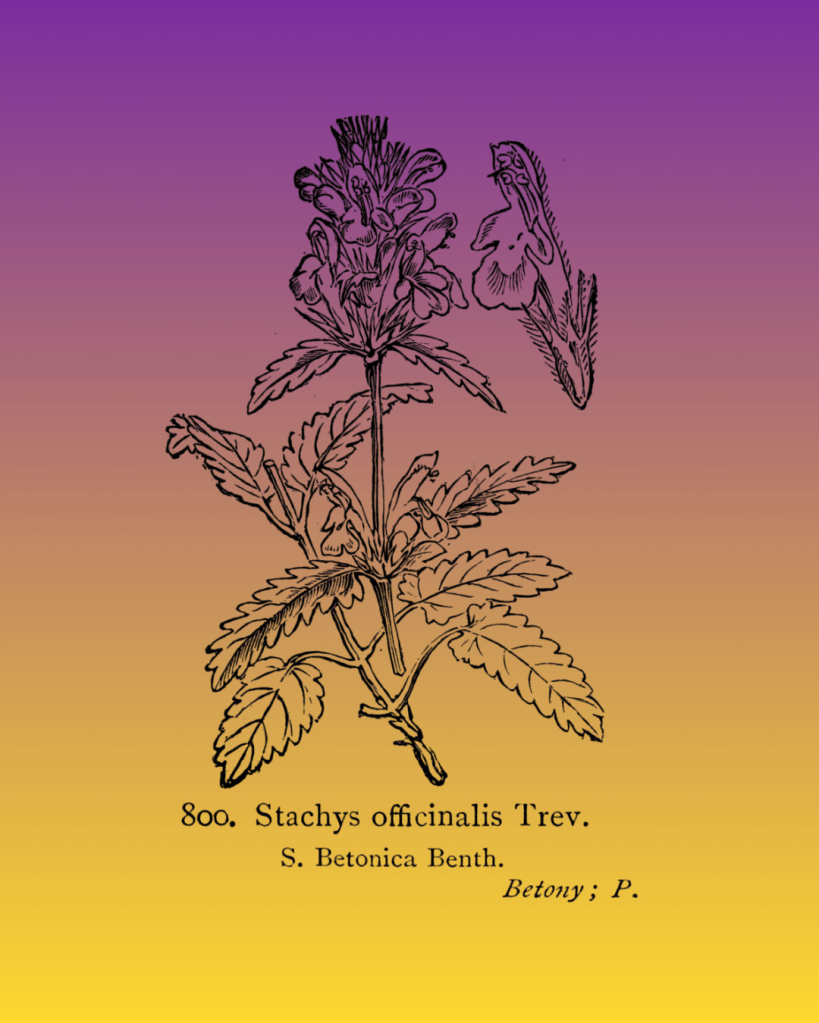
Stachys officinalis is slightly warming and drying. It’s a trophorestorative for the nervous system, meaning it gently supports a return to a sense of wholeness by nourishing and toning the system over time. It supports the nervous system via replenishing actions. As a mild carminative and bitter it may also support the digestive system acting as a kind of peacemaker along the gut brain axis. As an alterative, over time it can gently support balance in the processes of elimination. A mild astringent, it can tone and tighten tissues. In addition to being a nervine it is also a cephalic which supports circulation, clarity, and function in the brain. As a mild antispasmodic, betony can ease muscle tension.
Wood Betony can be a valuable and steady companion for those navigating recovery from the residue of past turbulence, which could show up as feeling scattered or perforated from emotional strain or experiencing mental fog or depletion. It can invite the body to a sense of cohesion after the brain has been floating in cyberspace for too long a time.
The Betony is a woodland plant that “delights in shady areas” (Culpeper). The parts used are the ariel parts: leaves, stems, and flowers. The roots are considered emetic and laxative though not recommended. Betony has been applied as an herbal infusion singularly and in blends. M. Grieve said it was referred to as poor mans tea and was sometimes used as a substitution. Betony has been tinctured, capsuled, and made into electuaries.
Wood Betony brings awareness back to the body and back into presence allowing for witnessing and integration with greater ease. This essentially is what is meant by “being grounded”. In many mystically inclined traditions water symbolizes emotions, while air or ether symbolizes thought… and solid ground serves as the container for balanced function.
Connecting plants to people is a holistic route. As a practicing herbalist I envision myself akin to the old timey telephone operators who listen to the callers and then say “Hold please. Let me connect your call”. Herbalism is about empowering people to reconnect to their unique vitality via a plant path. Patterns of plants and people can be complex. Having a deeper understanding of personal story and goals can assure that the right connection is made. Curious if Stachys officinalis/Wood Betony is aligned with your journey? Here’s how we can work together
“Betonica, dona lucem menti, stabilitatem interiorem, et praesentiam corpori.”
(“Betony, offer light to the mind, inner steadiness, and presence to the body.”)**
Hungry Ghost Syndrome* This is not an actual syndrome. I made it up because I am an artist and I find it metaphorically and poetically aligned.
Latin invocation** This is not ancient. I made it up loosely using the webs to translate it into Latin because I find Latin invocations to be fun and at times empowering. I wish I spoke Latin fluently. I do not.
Working with betony while pregnant or breastfeeding should only be done so with the guidance of an educated and experienced midwife or herbalist.
References
- Grieve, Maud. A Modern Herbal. London: Tiger Books International, 1998. “Wood Betony,” pp. 97–99.
- Culpeper, Nicholas (edited by Steven Foster). Culpeper’s Complete Herbal. New York: Sterling Publishing, 2007. “Wood Betony,” pp. 23–24.
- Hoffman, David. The Holistic Herbal. Rockport, MA: Element Books, 1990. “Wood Betony,” pp. 146, 173, 208–209.
- Wood, Matthew. The Book of Herbal Wisdom: Using Plants as Medicines. Berkeley, CA: North Atlantic Books, 1997. “Wood Betony,” pp. 165–177.
- Popham, Sajah. Evolutionary Herbalism: Science, Spirituality, and Medicine from the Heart of Nature. Berkeley, CA: North Atlantic Books, 2019. “Wood Betony,” pp. 479–481.
- Von Bingen, Hildegard. Physica: The Complete English Translation of Her Classic Work on Health and Healing. Translated by Priscilla Throop. Rochester, VT: Healing Arts Press, 1998. “De Betonica,” Book III, pp. 43–45.
All content was written by me. I used grammar editing support because not everyone enjoys the beatnik stream of consciousness style of writing that comes naturally to me. At the end of the day I want to connect people to plants… and I don’t have an editor.
This information is for educational purposes only and is not intended to diagnose, treat, cure, or prevent any disease. These statements have not been evaluated by the FDA. Please consult a qualified healthcare provider before beginning any herbal regimen, especially during pregnancy or while breastfeeding.
 Starhaven wellness